Thyroid RF (Radiofrequency Ablation): A Novel Advancement in the Non-Surgical Treatment of Thyroid Nodules**
#### **Introduction**
In recent years, significant advancements in medicine have led to minimally invasive methods replacing many traditional surgeries. One such innovative method is Thyroid Radiofrequency Ablation (RFA), recognized as an effective option for treating benign thyroid nodules, particularly those causing compressive or cosmetic symptoms. With minimal complications and a short recovery period, this method has created new hope for patients who are either unwilling to undergo surgery or are not suitable candidates for it.
#### **The Thyroid and the Importance of Its Health**
The thyroid is a butterfly-shaped endocrine gland located in the front of the neck. It secretes vital hormones such as T3 (Triiodothyronine) and T4 (Thyroxine), which play a fundamental role in regulating the body’s metabolism, growth, brain development, and the function of many organs. Dysfunction of the thyroid can lead to diseases like hypothyroidism or hyperthyroidism.
One of the most common thyroid problems is the formation of nodules (thyroid gland lumps). These nodules can be solid, cystic, or mixed, and are benign in most cases. However, some may grow large and cause symptoms such as:
* Difficulty swallowing or breathing (due to pressure on the esophagus and trachea)
* Voice changes (due to pressure on the laryngeal nerve)
* Cosmetic concerns (due to a visible bulge in the neck)
In such cases, treatment is essential.
#### **Traditional Methods for Treating Thyroid Nodules**
Before the introduction of minimally invasive techniques, the main treatment options for thyroid nodules included:
1. **Thyroidectomy Surgery (Removal of part or all of the thyroid):**
* **Advantages:** Definitive treatment for large or malignant nodules.
* **Disadvantages:** Requires general anesthesia, long recovery period, risk of damage to vocal cords, and potential lifelong hormone replacement therapy if the entire thyroid is removed.
2. **Alcohol (Ethanol) Injection into the Nodule (PEI):**
* Used for thyroid cysts but was ineffective for solid nodules.
3. **Hormonal Medication:**
* Prescribed in some cases to shrink nodules but had limited effectiveness.
Given the disadvantages of these methods, the need for a safer and more effective alternative led to the development of Thyroid RFA.
#### **What is Thyroid RFA?**
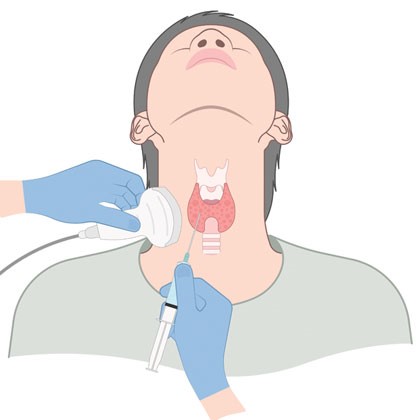
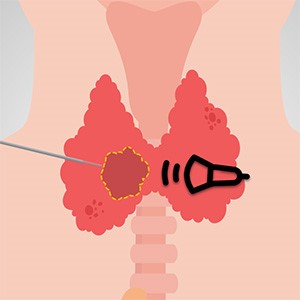
Radiofrequency Ablation (RFA or Thyroid RF) is a non-surgical procedure that uses high-frequency radio waves to generate heat and destroy the target tissue (the thyroid nodule). This procedure is performed under ultrasound guidance to increase precision and avoid damage to surrounding healthy tissue.
#### **Mechanism of Action of Thyroid RFA**
* A special needle (electrode) is inserted into the thyroid nodule.
* Radio waves are transmitted through this needle into the nodule tissue.
* The friction from the waves causes localized heating and denaturation of cellular proteins.
* This process leads to controlled necrosis (cell death) and the subsequent gradual shrinkage of the nodule.
#### **Applications of Thyroid RFA**
This method is used to treat:
✅ Benign thyroid nodules that cause compressive symptoms.
✅ Toxic (hormone-producing) nodules that cause hyperthyroidism.
✅ Nodules that are cosmetically bothersome.
✅ Patients who do not want or cannot undergo surgery (e.g., elderly patients or those at high risk for anesthesia).
#### **Advantages of Thyroid RFA Over Surgery**
🔹 **Minimally Invasive:** No need for surgical incisions or hospital stays.
🔹 **Local Anesthesia** (not general anesthesia).
🔹 **Short Recovery Period:** Patients typically return to normal activities the same day.
🔹 **No Need for Hormone Therapy** (unlike surgery, which may lead to hypothyroidism).
🔹 **Reduced Risk of Damage to the Laryngeal Nerve** (a common complication in surgery).
🔹 **Better Cosmetic Results** (no visible scar).
#### **Disadvantages and Limitations of Thyroid RFA**
🔸 **Ineffective for Malignant Nodules:** This method is only suitable for benign nodules.
🔸 **May Require Repeat Sessions:** More than one session may be needed to achieve the desired result.
🔸 **Relatively High Cost:** It is more expensive compared to some other methods.
🔸 **Operator-Dependent:** The accuracy of the procedure depends on the experience of the performing physician.
#### **Steps of Performing Thyroid RFA**
1. **Initial Evaluation:**
* Thyroid ultrasound and sometimes a biopsy (FNA) to confirm the nodule is benign.
2. **Patient Preparation:**
* The patient lies on their back with the neck slightly extended.
* The area is disinfected and local anesthesia is injected.
3. **Performing RFA Under Ultrasound Guidance:**
* The RF needle is precisely inserted into the nodule.
* Radio waves are applied, and the tissue is destroyed.
* The entire process usually takes between 15 to 45 minutes.
4. **Post-Procedure:**
* The patient is monitored for 1 to 2 hours.
* There might be minor temporary pain or swelling, controlled with common painkillers.
#### **Potential Complications of Thyroid RFA**
The procedure is very safe, but in rare cases, the following complications may occur:
⚠️ Mild pain or discomfort at the treatment site (temporary and manageable with painkillers).
⚠️ Minor bruising or swelling.
⚠️ Temporary voice change (due to irritation of the laryngeal nerve, usually resolves on its own).
⚠️ Very rare bleeding.
#### **Expected Results After Thyroid RFA**
* Nodule volume reduction (50% to 80%) within 3 to 6 months.
* Improvement in compressive symptoms (e.g., difficulty swallowing or breathing).
* Satisfactory cosmetic results (reduction of neck bulge).
* Supplemental sessions can be performed if needed.
#### **The Position of Thyroid RFA Compared to Other Ablation Methods**
Other methods like Laser Ablation (LA) and Microwave Ablation (MWA) are also used today to treat thyroid nodules. However, RFA remains a superior option for the following reasons:
🔷 Better temperature control (reducing the risk of damage to surrounding tissues).
🔷 Adjustable depth of penetration (more suitable for larger nodules).
🔷 Broader validation in clinical studies.
#### **Summary and Conclusion**
Thyroid RFA is a revolutionary method for treating benign thyroid nodules, providing results similar to surgery with minimal invasion. It is a true lifesaver for patients who fear surgery or are not suitable for an operation. Although it is not yet as common as surgery in some countries, it is expected to become a standard method in the future as scientific evidence grows.
If you also have a thyroid nodule and are looking for a low-risk alternative to surgery, Thyroid RFA can be an excellent option. However, the final decision should be made after consulting with a specialist and a thorough evaluation of your condition.
—
### **Frequently Asked Questions (FAQ)**
❓ **Is Thyroid RFA painful?**
No, with local anesthesia, very little pain is felt.
❓ **Does Thyroid RFA have long-term side effects?**
No, this method has no lasting side effects and can be repeated if necessary.
❓ **Is medication required after Thyroid RFA?**
No, unless the patient had a pre-existing thyroid condition.
❓ **Does insurance cover the cost of Thyroid RFA?**
It depends on the country and type of insurance. In some cases, it is covered.
❓ **Can the nodule grow back after RFA?**
In rare cases, recurrence is possible, but it is usually controlled with an additional session.
—