Breast Biopsy
Breast Biopsy by Interventional Radiology: A Precise and Minimally Invasive Method for Diagnosing Breast Lesions
A breast biopsy is an important diagnostic procedure used to examine suspicious lesions or lumps in the breast. It is particularly useful when imaging tests such as mammography, ultrasound, or MRI reveal abnormal masses. Breast biopsy performed by Interventional Radiology is a minimally invasive and precise method conducted under image guidance. This technique allows physicians to collect tissue samples from suspicious areas of the breast and send them to a pathology laboratory for further analysis. This article reviews this procedure, its steps, advantages, disadvantages, and important post-biopsy considerations.
Reasons for Needing a Breast Biopsy
A breast biopsy is usually performed in the following cases:
-
Suspicious Breast Lumps: If an abnormal mass is observed on a mammogram, ultrasound, or MRI, a biopsy may be necessary.
-
Changes in Breast Architecture: Such as calcifications (calcium deposits) that may indicate cancer.
-
Skin Changes: Like dimpling of the breast skin or abnormal discharge from the nipple.
-
Prevention and Screening: In some cases, a biopsy is performed to examine lesions that may potentially become cancerous in the future.
Methods of Breast Biopsy by Interventional Radiology
Breast biopsy by Interventional Radiology is typically performed using one of the following methods:
1. Ultrasound-Guided Biopsy
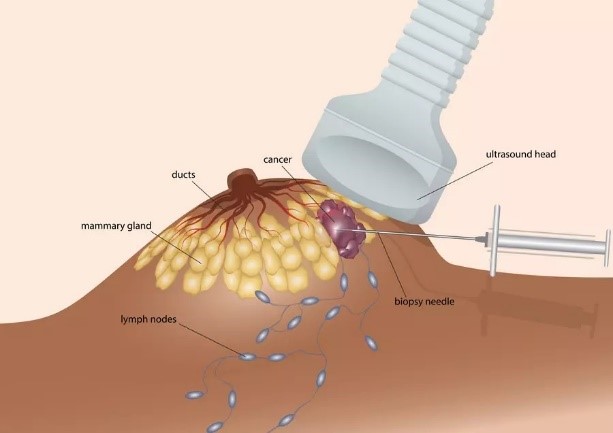
This method is used for lumps that are visible on ultrasound. Sound waves are used to guide the biopsy needle to the exact location of the mass.
2. Stereotactic Biopsy
This method is used for lumps detected by mammography. Mammographic images are used to precisely locate the mass and guide the biopsy needle.
3. MRI-Guided Biopsy
This method is used for lumps that are only visible on MRI. MRI images are used to guide the biopsy needle to the exact location of the mass.
Steps of Performing a Breast Biopsy by Interventional Radiology
-
Initial Evaluation: Before the biopsy, the patient undergoes an examination and imaging to determine the location and size of the mass.
-
Local Anesthesia: The area of the breast to be biopsied is numbed. This reduces pain and discomfort during the procedure.
-
Biopsy Needle Guidance: Using imaging (ultrasound, mammography, or MRI), the biopsy needle is guided to the exact location of the mass.
-
Tissue Sample Collection: The biopsy needle collects small samples of the tissue from the mass. This may be repeated several times to gather sufficient samples for laboratory analysis.
-
End of Procedure: After the biopsy is completed, the samples are sent to the pathology lab, and the biopsy site is bandaged. The patient is usually discharged on the same day.
Advantages of Breast Biopsy by Interventional Radiology
-
High Accuracy: This method allows physicians to collect tissue samples from the exact location of the mass, reducing the risk of error.
-
Minimally Invasive: No large incisions or general anesthesia are required.
-
Rapid Results: The collected samples are sent to the lab quickly, and results are usually available in a short time.
-
No Hospitalization Required: Patients are typically discharged on the same day and can return to their normal activities.
-
Reduced Risk of Infection: Due to its minimally invasive nature, the risk of infection is very low.
Disadvantages and Complications of Breast Biopsy
-
Pain and Discomfort: Some patients may experience mild pain or discomfort at the biopsy site.
-
Bruising and Swelling: Bruising or swelling may occur in the breast area after the biopsy.
-
Bleeding: In rare cases, bleeding may occur at the biopsy site.
-
False-Negative Results: In some instances, a biopsy may fail to detect cancer, especially if the samples are taken from non-cancerous areas.
Post-Biopsy Care
-
Rest: Patients can usually return to normal activities on the same day but should avoid strenuous activities for a few days.
-
Cold Compress: Using a cold compress can help reduce swelling and pain.
-
Monitoring Symptoms: Patients should watch for symptoms such as fever, redness, severe swelling, or abnormal discharge from the biopsy site and consult their doctor if these occur.
-
Follow-up on Results: Patients must follow up with their doctor to receive the biopsy results and determine the next steps in treatment.
Conclusion
Breast biopsy by Interventional Radiology is a precise and minimally invasive method that plays a key role in diagnosing breast lesions. Using advanced imaging, this technique allows physicians to collect tissue samples from the exact location of a mass, reducing the risk of error. Despite its significant advantages, the procedure may be associated with complications such as pain, bruising, or bleeding, which require careful care and monitoring.
Ultimately, the decision to perform a biopsy should be made in consultation with a specialist and based on each patient’s specific condition. With ongoing advancements in medicine, it is hoped that innovative diagnostic methods like breast biopsy by Interventional Radiology will contribute to improved treatment outcomes and reduced side effects for patients with breast lesions.